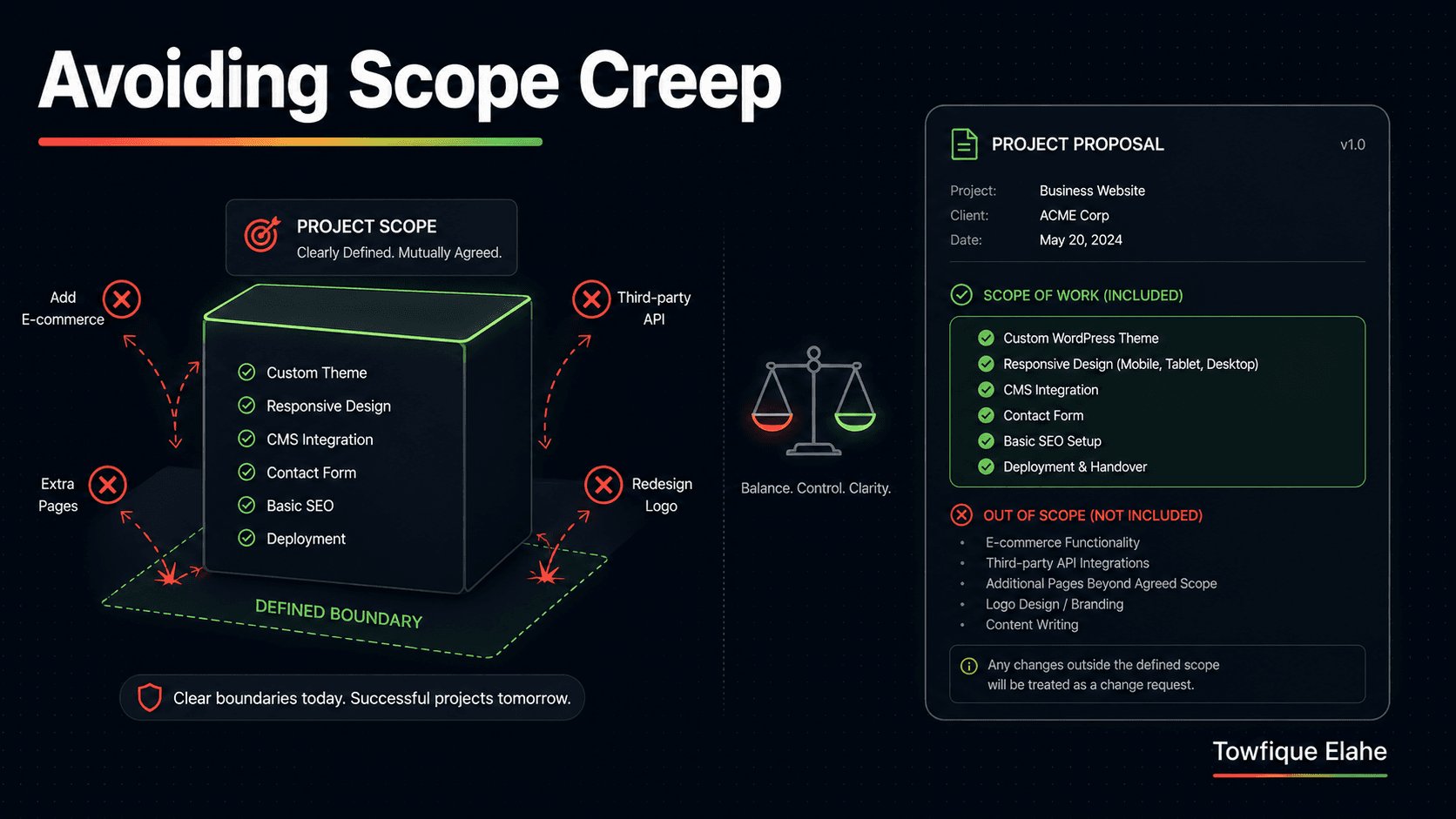
How to Scope a Web Project and Avoid Scope Creep
Scope creep is the silent killer of freelance profitability — the endless "small extra requests" that turn a two-week project into a two-month ordeal for the same fee. Learn how to scope a web project properly, write a proposal that protects you, and handle out-of-scope requests without damaging the relationship.
What Scope Creep Actually Is
Scope creep is the gradual, often invisible expansion of a project beyond what was originally agreed — usually without any matching change to the timeline or the fee. It rarely arrives as one big demand. It comes as a series of small, reasonable-sounding requests: "Can we also add a blog?" "Just one more page." "Can you make the logo bigger... and while you're at it, redesign the header?"
Each request seems trivial in isolation. Together, they can double or triple the actual work for the same money — quietly destroying the profitability of an otherwise good project. For freelancers and small agencies, unmanaged scope creep is one of the biggest reasons projects become stressful and unprofitable.
The solution isn't to be rigid or difficult. It's to define scope clearly up front and handle changes through a simple, fair process. This guide covers both.
Why Scope Creep Happens
Understanding the root causes helps you prevent it. Scope creep almost always comes from one of these:
- Vague initial agreements. If the scope was never clearly defined, everything is arguably "in scope." Ambiguity always expands in the client's favor.
- Clients not knowing what they want. Many clients genuinely discover their requirements as the project progresses. This is natural — but it needs to be managed.
- The "while you're at it" reflex. Once work is underway, it feels efficient to the client to pile on related requests.
- Fear of saying no. Freelancers, especially early on, worry that pushing back will damage the relationship — so they absorb the extra work silently and resent it later.
Notice that most of these are preventable at the very start of the project, before a single line of code is written.
Step 1: Define Deliverables, Not Vague Goals
The foundation of scope control is a clear, specific list of deliverables. "Build a website" is not a scope — it's an invitation to scope creep. A real scope names exactly what's included.
Compare these two definitions of the same project:
Vague: "Design and build a company website."
Specific: "Design and build a 5-page WordPress website consisting of: Home, About, Services, Blog, and Contact pages. Includes a contact form, mobile-responsive design, basic on-page SEO setup, and integration with the client's existing domain and hosting."
The second version leaves almost no room for interpretation. Everyone knows exactly what's being delivered — and just as importantly, what isn't. That clarity is your primary protection.
Step 2: Explicitly State What's NOT Included
This is the step most freelancers skip, and it's one of the most powerful. Alongside what's included, list what's out of scope. This sets expectations before they can become disputes.
For example, an "Out of Scope" section might read:
- Logo design and brand identity (client provides existing branding)
- Content writing and copywriting (client provides all text)
- Product photography or stock image licensing
- Ongoing maintenance after launch (available separately)
- E-commerce or payment functionality
- More than two rounds of revisions
When a client later asks for something on this list, you're not saying no out of nowhere — you're referring back to something you both already agreed on. That's a far easier and more professional conversation.
Step 3: Define the Revision Policy Clearly
Revisions are where scope quietly explodes. Without limits, "a few tweaks" can become an endless cycle of changes. Always specify the number of revision rounds included, and what happens beyond that.
A clear revision clause looks like:
"This project includes two rounds of revisions per design stage. A 'round' means one consolidated set of feedback. Additional revision rounds beyond those included are billed at [rate] per round."
Defining a "round" as one consolidated set of feedback is key — it prevents the drip-feed of one small change at a time, each triggering a new cycle. It also gently encourages clients to gather their thoughts and give you complete feedback at once, which is better for everyone.
Step 4: Put a Timeline and Milestones in Writing
A defined timeline with milestones does two things: it keeps the project moving and it makes scope changes visible. When work is broken into stages — discovery, design, development, revisions, launch — adding something new obviously affects the schedule, which makes the cost of scope changes concrete rather than hidden.
Tie payments to milestones where possible. A common structure is a deposit up front, a payment at design approval, and the balance before launch. This protects your cash flow and gives natural checkpoints where scope is reviewed and confirmed before moving forward.
Step 5: Write a Proposal That Protects You
Your proposal or contract is where all of this comes together. A solid project proposal should include:
- Project overview — a short summary of what you're building and the client's goals.
- Detailed deliverables — the specific, itemized list of what's included.
- Out-of-scope items — what's explicitly excluded.
- Timeline and milestones — key dates and stages.
- Revision policy — how many rounds, and the cost of extras.
- Payment terms — amounts, schedule, and methods.
- Change request process — how new requests are handled (covered next).
Even for small projects, get agreement in writing. It doesn't have to be an intimidating legal document — a clear, signed proposal email is far better than a verbal understanding that both sides remember differently three weeks later.
Step 6: Create a Change Request Process
Here's the crucial mindset shift: the goal isn't to prevent all changes — it's to manage them. Clients will always have new ideas, and often those ideas are good. A change request process lets you say "yes, and here's what that involves" instead of either refusing or absorbing the cost.
When an out-of-scope request comes in, the process is simple:
- Acknowledge it positively. "That's a great idea, and it's definitely something we can add."
- Flag it as out of scope, without drama. "That's outside what we defined in the original scope, so let me put together what it would involve."
- Quote the time and cost. Give a clear estimate for the additional work.
- Let them decide. The client chooses whether the addition is worth it. Either way, you're protected.
This reframes every extra request as a business decision for the client rather than free work for you. Most reasonable clients respect this — it shows you run a professional operation.
Step 7: Use the Magic Phrase
When you need to address an out-of-scope request in the moment, one phrasing pattern handles it gracefully nearly every time:
"I'd be happy to add that. Since it's beyond our original scope, it'll add [X] to the timeline and [Y] to the cost. Want me to go ahead?"
This works because it's not a refusal — it's an enthusiastic yes with clear terms attached. You're not the difficult freelancer who says no; you're the professional who's transparent about what things cost. That distinction protects both your income and the relationship.
Handling Scope Creep That's Already Happening
What if you're already mid-project and the creep has started? It's not too late to regain control:
- Pause and document. List what was originally agreed versus what's now being asked. Seeing it written down often makes the expansion obvious to both sides.
- Have an honest conversation. "I want to make sure we deliver everything you need. Looking at the recent requests, several go beyond our original scope — let's align on how to handle them."
- Offer a path forward. Present the additions as a change request with cost and timeline, rather than silently eating them or abruptly refusing.
Most clients aren't trying to take advantage — they simply lost track of the boundary. A calm, factual reset usually resolves it without conflict.
The Balance: Firm but Not Rigid
Scope control isn't about nickel-and-diming clients over every tiny request. Small, quick additions that genuinely take five minutes are often worth doing for goodwill — and building that goodwill matters. The judgment call is recognizing the difference between a minor courtesy and a meaningful chunk of unpaid work.
A good rule of thumb: if a request takes a few minutes and improves the relationship, absorb it graciously. If it represents real hours or a new feature, run it through the change request process. Over time, this balance earns you a reputation as someone who's both easy to work with and professional about their time.
Final Thoughts
Scope creep isn't beaten with rigidity — it's beaten with clarity. A specific, written scope that defines both what's included and what isn't, a clear revision policy, and a simple change request process together eliminate almost all of the conflict and lost profit that scope creep causes.
The freelancers and agencies who stay profitable aren't the ones who say no to everything. They're the ones who make the boundaries visible from day one, then handle every new request as a straightforward, fair business decision. Define the box clearly, and you control what goes in it.
In the next post, we'll look at the tools and systems that make client projects run smoothly — the project management, communication, and file-handling setup that keeps freelance work organized as you take on more clients.