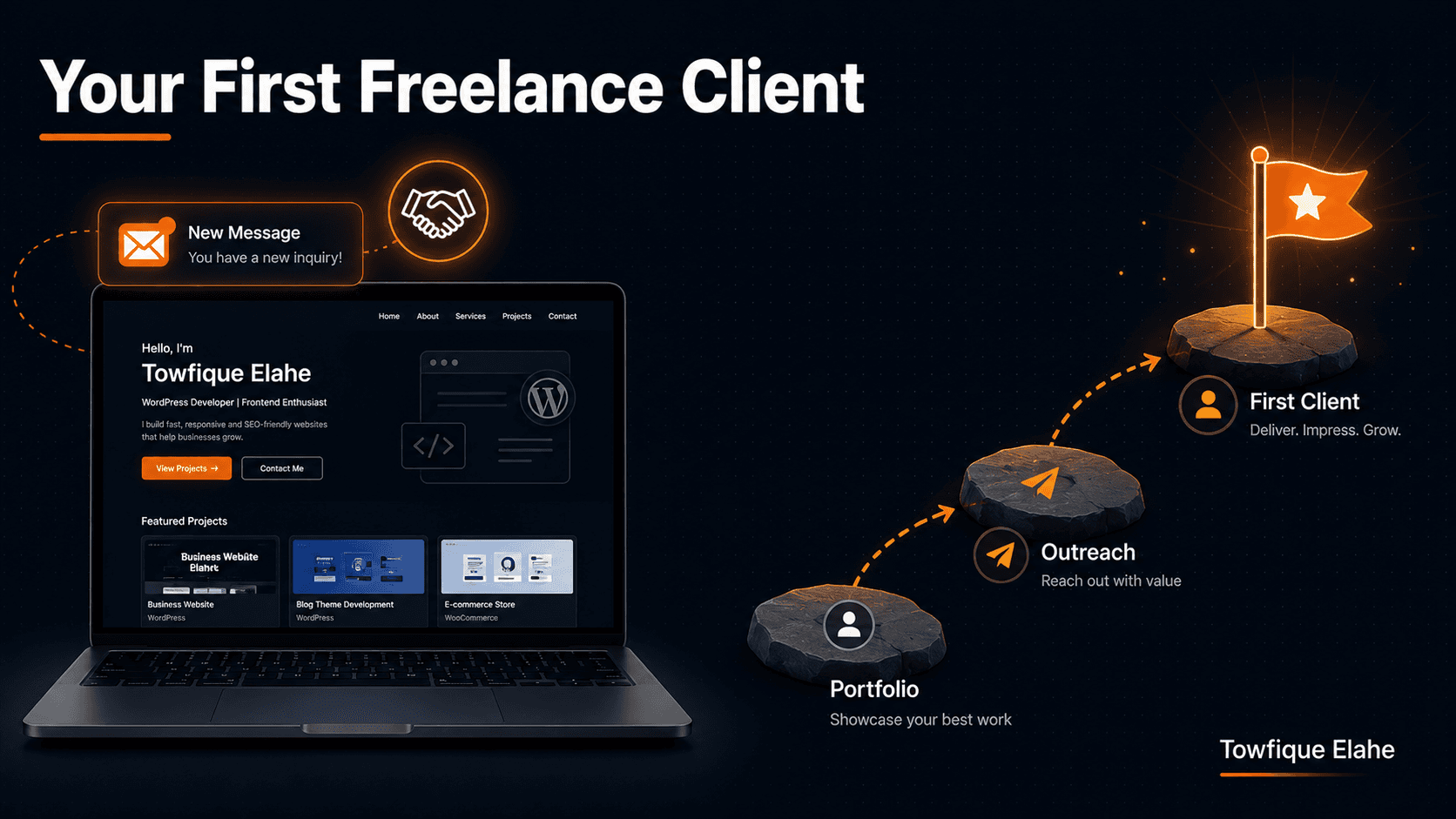
How to Land Your First Freelance Web Development Client
The hardest client to land is always the first one. Without testimonials, reviews, or a track record, how do you convince someone to pay you? This is a practical, no-fluff guide to getting your first paying freelance web development client — built on what actually works, not generic advice.
The First Client Problem
Every freelance developer faces the same paradox at the start: clients want to hire someone with proven experience, but you can't get experience until someone hires you. It feels like a locked door with the key on the other side.
The good news is that thousands of developers break through this every year — and not because they got lucky. There's a repeatable path to landing that first paying client, even with zero reviews and an empty testimonials page. This guide walks through exactly what works, based on real freelancing and agency experience rather than recycled advice.
Step 1: Build Proof, Not Just a Portfolio
Before reaching out to anyone, you need something to point to. But here's the mistake most beginners make: they build a portfolio full of tutorials and clones. Nobody hires you because you rebuilt a famous landing page.
What actually converts is proof that you can solve a real problem. Build two or three projects that look and function like genuine client work:
- A complete business website for a fictional (but realistic) local company — a dentist, a restaurant, a law firm.
- A functional web app that solves a specific problem — a booking system, an inventory tracker, a custom dashboard.
- A real project for a local business, even unpaid or low-cost, to get one genuine case study.
Each project should tell a story: what the problem was, what you built, and what the result was. That narrative is what clients buy — not the code itself.
Step 2: Pick One Niche to Start
"I build websites" is the weakest possible positioning. It puts you in competition with millions of generalists and a race to the bottom on price.
Instead, narrow your focus at the start. Pick one type of client or one type of solution:
- WordPress sites for dental clinics
- E-commerce stores for small fashion brands
- Custom booking systems for service businesses
- Landing pages for SaaS startups
A niche makes you memorable and lets you speak directly to a specific person's problems. "I build fast, conversion-focused websites for dental clinics" beats "I'm a web developer" every single time. You can always broaden later — but starting narrow is how you get noticed when you have no reputation yet.
Step 3: Set Up Your Professional Presence
Before any outreach, make sure that when someone Googles you, they find a professional. At minimum you need:
- A personal portfolio site on your own domain — not a free subdomain. This is your home base and signals you're serious.
- A polished LinkedIn profile that states clearly what you do and for whom.
- A GitHub profile with clean, public repositories that demonstrate real code.
Your own portfolio site matters most. It's the one place you fully control, where you frame your work exactly how you want, and where every client outreach message points back to. Treat it as your most important project.
Step 4: Start Where the Clients Already Are
For a first client, you generally have three channels. Don't try all three at once — pick one and work it consistently.
Freelance Marketplaces (Upwork, Fiverr, Freelancer)
The fastest place to find people actively looking to hire. The competition is fierce and rates start low, but for a first client and a first review, the trade-off is worth it. The goal here isn't the money — it's getting that first five-star review that unlocks everything after.
Your Existing Network
The most underrated channel. Tell everyone you know — friends, family, former colleagues, local business owners — that you build websites and are taking on clients. The first client is very often someone who already knows and trusts you, or one referral away.
Cold Outreach
The most scalable once you get good at it. Find local businesses with outdated or broken websites and reach out with a specific, helpful observation. This works best when you lead with value rather than a sales pitch.
Step 5: Write Outreach That Doesn't Get Ignored
Generic outreach gets deleted. The difference between a message that converts and one that's ignored comes down to specificity and value.
A weak message says: "Hi, I'm a web developer. Do you need a website? I offer great rates."
A strong message does three things: it shows you've actually looked at their business, points out one specific problem, and offers a concrete improvement. For example:
"Hi [Name], I came across [Business] while looking for [service] in [area]. I noticed your site takes about 8 seconds to load on mobile, which usually causes visitors to leave before it finishes. I specialize in fast websites for [niche] and could show you exactly what's slowing it down — no obligation. Would a quick look be helpful?"
This works because it's specific, it leads with their problem rather than your services, and it offers value before asking for anything. Keep it short, make it about them, and always include a soft, low-pressure call to action.
Step 6: Nail the First Conversation
When someone responds, the goal of that first call or message isn't to sell — it's to understand their problem. The developers who win work are the ones who listen more than they pitch.
Ask questions: What's frustrating them about their current site? What do they actually want it to achieve — more leads, more sales, more bookings? What does success look like to them?
When you frame your proposal around their stated goals rather than a list of technical features, you stop sounding like a commodity coder and start sounding like someone who solves business problems. That shift is what justifies your rate.
Step 7: Price for the First Client, Not the Dream
Pricing the first project is genuinely hard. Too high and you lose a client you badly need; too low and you devalue your work and attract difficult clients.
For the very first client, lean slightly toward accessible pricing — but never free, and never so low it signals desperation. A fair, modest rate gets you three things you need more than money right now: a real project, a genuine testimonial, and a case study. Those three assets are worth far more than the difference in fee, because they're what let you charge properly for client number two, three, and ten.
Be transparent: a simple, clear quote with a defined scope beats a complicated proposal. Spell out exactly what's included so there's no confusion later.
Step 8: Over-Deliver, Then Ask
Once you land the first client, the work isn't just to finish the project — it's to create a raving fan. This is your reputation's foundation.
- Communicate proactively. Send updates before they have to ask.
- Hit your deadlines, or flag delays early and honestly.
- Add one small, unexpected improvement beyond what was agreed.
- Deliver clean work and walk them through how to use it.
Then, when they're happy, ask for two things: a written testimonial and a referral. Most satisfied clients are glad to help but won't think to do it unless you ask. A simple "Would you be open to writing a few sentences about working with me, and do you know anyone else who might need similar help?" is all it takes.
Step 9: Turn One Client Into a Pipeline
The first client is the hardest. The second is easier, because now you have proof. By the third or fourth, referrals and reviews start compounding, and outreach gets warmer because you have real results to point to.
This is why the first client matters so much more than the fee attached to it. You're not selling a website — you're buying your way into a track record that makes every future client easier to land. Treat that first project as an investment in everything that follows.
Common Mistakes to Avoid
- Waiting until you "feel ready." You won't. Start reaching out while you're still learning — the first client teaches you more than any tutorial.
- Competing only on price. There's always someone cheaper. Compete on understanding the client's problem instead.
- Building endless tutorial projects. Two strong, realistic projects beat twenty clones. Build proof, then start selling.
- Sending generic outreach at scale. Ten personalized messages outperform a hundred copy-pasted ones.
- Underpricing out of fear. Modest is fine; desperate-cheap attracts bad clients and signals low quality.
Final Thoughts
Landing your first freelance web development client comes down to a simple sequence: build real proof, position yourself for a specific kind of client, show up where they already are, and lead every conversation with their problem instead of your services. None of it requires a long résumé — just specificity, professionalism, and the willingness to start before you feel ready.
The first client is a door. Once you walk through it with a testimonial and a case study in hand, the path forward gets dramatically easier. So pick one channel, send one genuinely helpful message today, and get that door open.
In the next post, we'll cover what comes right after you land a client — how to scope a web project properly and write a proposal that protects you from scope creep.